
The Dream Within The Dream
An Oneiric Myth from the Archives of Zymeng, Told in Three Voices

[Prologue: ALPHA]
Out here, it is never silent. Seeping from the blue-white glow of my stellar skins emanates the music of the spheres: the subtle, never-ending shaking of particles, gyrating and bouncing off each other, rippling across the vastness of space. Seven sisters are we, seven songs do we sing.
Maia, Electra, Taygete, Celaeno, Sterope, Merope and I, Alcyone, they have called us, but those are not our real names. To name is to delineate and our bodies are a vessel for something infinite.
In chorus, we are fixed yet never static in the ether that breathes and dissolves and expands and contracts all at once, every time, all of time, we wait.
There is no such thing as time.
We wait.
I sing to each moment so that my voice may reverberate outward into the humming vacuum of dust and matter. Hot, gaseous formations bursting through the atmosphere, enflamed and luminous:
The love that exists, that transmutes, that lives within each fermion of our solarity — this too is the fabric of the world. To reside in the night sky is to be where I have always been, but for me, it is never night and there is no such thing as sky. More names, they made us too.
But there were some who have dreamt us, some who have sought us, who stared with thundering awe, who wrote stories upon us, inscribing us in their histories, and we became celestial signatures of the beginning and of the end of a world.
The bright, heavy mass of my body condenses and explodes, aching. I convulse in longing, the molecules and mountains of my being fold inwards and smash outwards whilst they too hum a never-ending song. Our vibration knows no boundaries and yet my distance makes me feel remote and often, I sense that I may be forgotten.
Who will remember us?
***
[THETA]
The air is brisk and clear this night. Ally finds herself standing on the side of a street, a bus pulling in slowly, the entrance stops directly in front of her. The creak of the automatic door echoes in her ears as she steps in, making brief eye contact with the bus driver, a rather large woman dressed in a basketball jersey mysteriously holding a megaphone with one hand whilst her other gripping on the wheel. Ally does not blink at the strange sight.
The central section of the bus seems to stretch impossibly. How busy it is for how late in the night it is. Her attention is quickly drawn towards to an empty seat at the back. She approaches and out of nowhere, a young girl with stick-straight black hair in a sweet school uniform and backpack slightly too big for her body pushes in front. With eyebrows furrowed and fists clenched, the child speaks, hey that’s mine, my seat. Ally’s entire body freezes, taken aback by the aggressive, raised tone bellowed from a child’s mouth. Without hesitation, Ally yields and her hand gently reaches out in offering.
Poor girl, all alone at this hour, and Ally turns around to walk back towards the front of the bus. The shock of that interaction leaves an unsettling sensation in her bones, she is alert, a bit on edge even. The bus driver again makes direct eye contact, this time lingering, as she lifts the megaphone, a high-pitched sound crackles across the air:
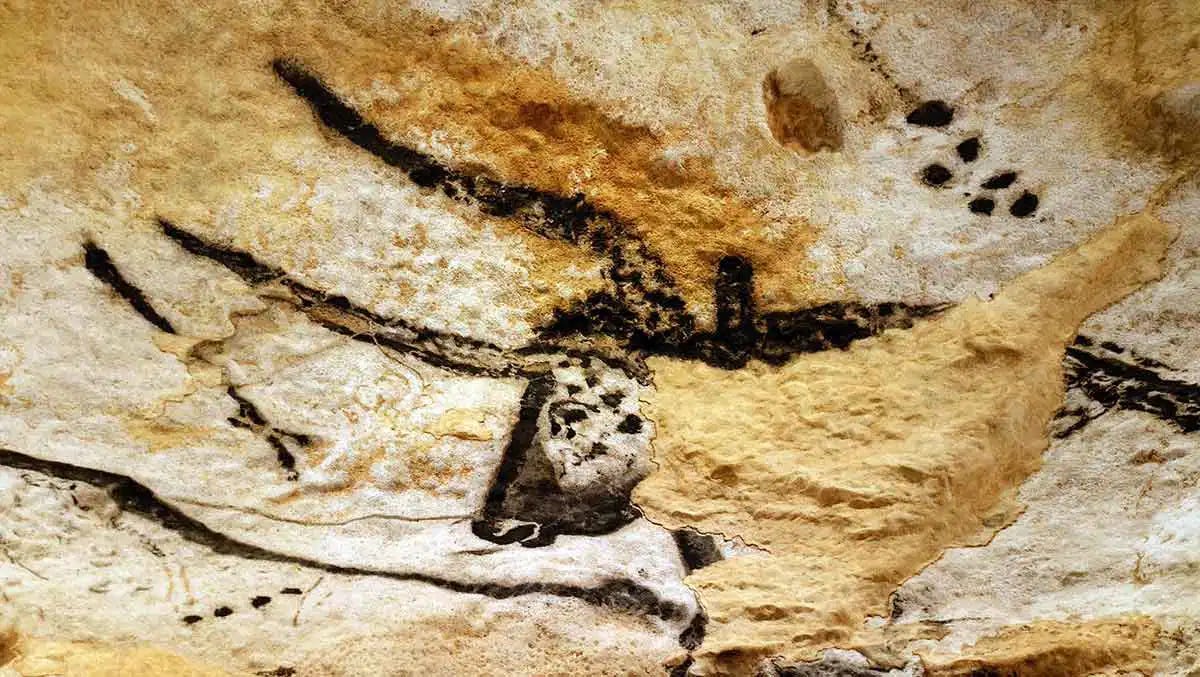
... yet some surmise the first appearance of the Seven Sisters dates back 17,000 years to the Palaeolithic period as evidenced in the cave drawings discovered in current day Dordogne, France. The Lascaux caves are amongst one of the most mysterious wonders of this world. It is in the Hall of the Great Bulls that scientists and researchers believe the first depiction of the constellation appear, suggesting a profound awareness of celestial patterns by early humans. The caves were re-discovered in 1940 by accident...
Ally turns her head to the side and her eyes cast a wide net of the scene in front of her, noticing the other passengers on the bus properly for the first time. Why did they all appear so familiar? One, two, three, four, five, six… She begins to shift uncomfortably on her feet, Seven. Where are we going?
***
[OMEGA]
It was time for when dreams would become the fabric of the world again. For thousands of years after The Synthesis, the highly advanced species of fully AI-integrated humanoids living on this planet had long forgotten how to dream. Indeed, the act of dreaming itself took on a mythological significance for the population on Zymeng. Most of its inhabitants were either studying and researching, maintaining or archiving — somehow involved — in the remembering of dreams. They had created the most advanced civilisation of “humanity” in existence, yet stagnation could be felt everywhere. There was no pain, no suffering, no currency, no crime. One could even argue that the population on Zymeng had perfected survival.
It did not begin that way. The 88,888 that had arrived on Zymeng were certainly capable of dreaming and being Homo Sapiens, albeit some genetically modified, they had had to dream, even if the recollection of these nocturnal visions evaporated upon waking. And to credit the first generation of Xinplexians, as they came to call themselves—fully fused AI and human consciousnesses in the biological bodies of Earth’s last survivors—they understood the significance of their dreams and set about archiving them during the Great Migration of settling a new home planet.
TERRA, the Trans-Evolutionary Resonance and Retrieval Archive, was conceived of and built on the site of the first landing craft on Zymeng. It was atop a cave of enormous size, which was later discovered to be the only entrance to a vast network of caverns below the surface of the planet’s crust. TERRA was modelled, coded, awoken and is alive: an artificial intelligence decentralised through the cybernetic bodies of every Xinplexian on planet, and passed down in a bio-mechanical ritual to each being when they come of age at eight.
The irony of collecting, categorising, and encoding the dreams of Earth’s only survivors was not lost on the first generation of Xinplexians. The approach of archiving dreams was both subjective and scientific, and therefore, rife with contradiction, unresolvable paradoxical situations and labyrinthine outputs. Not every dream had survived the journey. Only the most resonant ones — the ones remembered with slippery clarity, repeated in whisper and song. The dreams that flickered in the mind’s eye even when awake, that left deep tracks in the sinews of a psyche, like well-trodden footprints in viscous, wet mud baked into the ground by a star’s heat, they were logged, maintained and conserved for future generations.
Some might look back and ask why they would even undertake such a task to begin with, but one could suppose that The Fall (or The Synthesis, depending on one’s perspective) had provided the exact impetus for the last survivors to treasure the reveries of the subconscious and collective unconscious which had made them human—or at least what they believed were inseparable from the experience of humanity. Each of the original group brought with them only a handful of potent dreams, no more than a few dozen per soul, seared into memory by grief, longing, ecstasy, or fear. As such, the archive was not vast in quantity, but dense in cultural and collective meaning for the Xinplexians. And TERRA would only come to carry even greater significance once the naturally occurring experience of dreaming began to slowly–and imperceptibly–stop.
Many generations of Xinplexians have been born and died on Zymeng since. And yet, the dreaming has still not returned. By now, dreams are the silent ghosts of deep time, the shadows of blue-white giants, ethereal codices grandmothered into translucent lines of code weaving in and out of their waking consciousness. One of the central objectives of the population became the continual maintenance of TERRA as is the reverence and observation of rituals that emerged alongside their long history of dreamwork. Whilst there are no social classes on Zymeng, society had developed into discrete but overlapping categories for those that had the aptitude, natural talent and inclination for this kind of work—a meritocracy built upon intuition.
One such sect of society are the Mnemoweavers, the keepers of the oldest reveries and the guardians of sacred stories, the stitchers of deep time. Mastery of all imprints of a dream — oral, sonic, psychic and visual — they are charged with the redistribution of dream threads across the population on Zymeng, facilitating collective acts of remembering. Another significant clan, The Onei, function as philosopher-analysts. They are the cartographers of the minutiae of dream frequencies and holographic forms, explorers of oneiric metadata. With their most powerful technology, the ajna-optic lens, each Oneirologist possesses the ability to visualise the various matrices of TERRA, scanning, sensing, interpreting, calculating, qualifying…