
On Love, A Quantum Field
A Personal Cartography

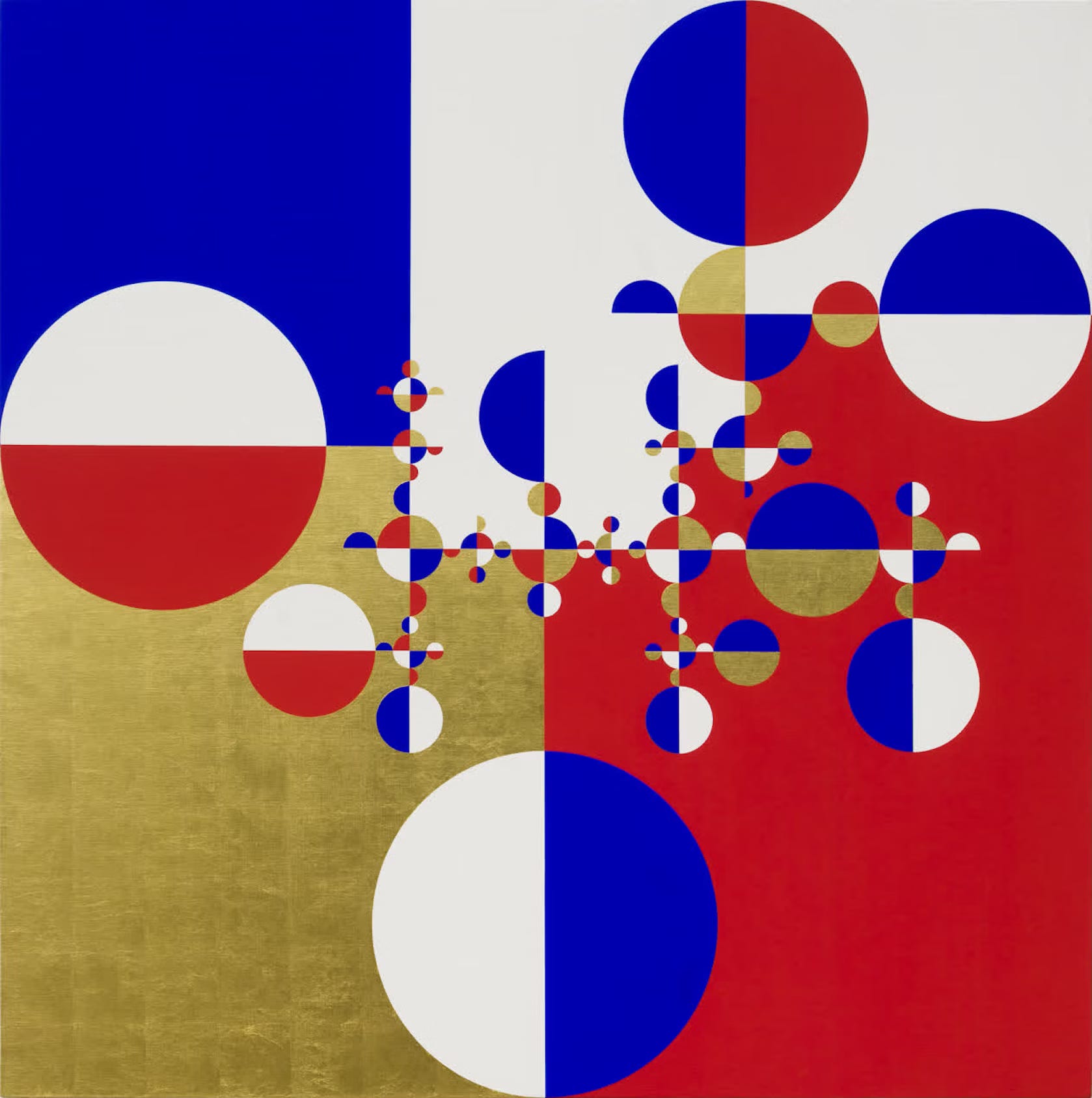
AN INCOMPLETE MAP
The idea that each of us possesses a “love language” first emerged in the self-help boom of the nineties. Since then it has been popularised into mainstream collective consciousness via internet quiz culture and social media as a pseudo-psychological tool for our complex relationality today. The five primary “languages” are generally considered to be words of affirmation, quality time or presence, gift (symbolic) giving, acts of service, and physical touch. This framework remains captivating because it provides clear narrative scripts on how to make sense of our interpersonal dynamics in an age of increasing complexity and confusion, especially in a world still enthralled by rationalism. And naturally, because it resonates on some collective level: in daily life, we do perform love through care, through action, through speech.
But that a thing as ineffable and profound as love could ever be systematised into coherent “language” seems impossible to me and yet, here we are, trying. We need language and its forms (speech, writing, gesture) to communicate, to connect with others and to dream together. Both the contemporary pop-psychology of “love languages” and the ancient art of mythic storytelling share the same underlying impulse: the wish to map what can never be truly drawn faithfully and accurately. One might render love into categories, the other in symbolism. Yet, my intuition says love existed long before language, just as dreams inhabited us before the written word began to inscribe itself on our memories. Love moves through us long before we learn how to speak of it or can make sense of what it asks of us. Before it became a feeling or an ideal, love was a force that vibrated through cosmologies and bodies eons before reason tried to domesticate it into coherence.
This essay is a personal cartography of love as vital force: partial, contradictory, subjective and unstable – a sketch of some of the ways it has made itself known to me. And like all maps, this one will be incomplete, perspectival and at times, unreliable. This is an exercise not in claiming or delineating territory, like some maps have been used for, but an attempt to draw some coordinates across my interior world where it continues to surface and resurface.
A few weeks ago, I attended the book launch and exhibition opening of The Word for World: The Maps of Ursula K. Le Guin published by Silver Press. What I went away with was the realisation that beyond these initial caveats, map-making remains a potent tool for the creation of worlds and of mythologies. Ananda Coomaraswamy once wrote ‘myth embodies the nearest approach to absolute truth that can be stated in words.’1 Elsewhere, in 1986, Le Guin penned ‘We are volcanoes. When we women offer our experience as our truth, as human truth, all the maps change. There are new mountains.’2 A map, then, is a powerful entity for dreaming up new realities and fields founded upon their own internal logic.
WHAT COUNTS AS LOGIC?
If love were a legible map, how would it be designed? Who would make it and for whom would it be made? What would it say or show? What stories would it tell? And indeed, what language would it use? Admittedly, there is no apparent “logic” when it comes to questions of the heart.
Indulge me for a moment regarding our central term here – logic – from the Greek etymological root logos, referring to word, speech, reason, principle, ratio and proportion. It is about those things which are spoken, ordered, gathered and made intelligible. There is the logic that most readily resembles common sense: a practical, everyday mode of interaction. In other words, the processes and contexts where a coherent and immediate thinking through of something with one’s mentality is required.
Then there is another sense of logic – one that functions in a broader, cultural register: that which structures or rules an underlying system. We can speak of the logic of capitalism, the logic of history, or the logic of practice. However, there is often an assumption of a framing or perspective when applied to these. I’ve observed that this type of broader logic has a great effect on each person’s lens in the world and therefore, engages on multiple levels: cerebrally, psychologically, emotionally and somatically. These are vast and complex matters that texture experience and knowledge as much as they inform them. These logics are arguably predicated on the unfurling of culture – an interlocking, ever-evolving matrix of beliefs, symbols, practices, materials, languages and relationships over time.
And there is yet another reading of logic: Greek philosopher Heraclitus of Ephesus proposed a “world of perpetual change, of eternal ‘Becoming’…[where] all changes in the world arise from the dynamic and cyclic interplay of opposites… [and] any pair of opposites [is] a unity.”3 He called this “unity,” the Logos. It is this framing of logic that I find the most productive for this cartographical expedition. If Logos, in this older sense, names the field that holds opposites in generative tension, then what we call “logic” today, especially in syllogistic form, resonates like a faint murmur of its original meaning. The modern emphasis on clarity, reason, proof, and binaries of true-false is a thin slice of a once-expansive principle.
Love, by contrast, seems to operate amidst that older terrain: a space where contradiction does not negate meaning but produces it; where paradox does not collapse inquiry but animates it. In this sense, love does not obey any logic — it may be itself be a logic. Not the Aristotelian one of deduction and exclusion, but the Heraclitean one of flux, polarity, and unity-within-opposition. If so, then to map love is not to seek consistency but to trace a pattern that refuses to be settled, a pattern that renews itself through movement, ambiguity and mystery.
UNDER A URANIAN NIGHT SKY
Lately, I have been moving through a Uranus-Moon transit – a season that astrologers often describe as one of personal and internal revolution. I feel it. With or without my conscious choice, I am being asked to contend with the unfamiliar, to inhabit forms of self wholly new, untested and strange, to break from the circuitry of past roles too. There is an inherent restlessness there, a flicker of rebellion I already recognise but feel more amplified now: a desire to change and to be changed.
The art and practice of astrology is itself a kind of map – a symbolic framework of the relationality of celestial objects and their gravitational forces. Symbolic, because whilst planets and stars are indeed “objects” within our galaxy, the macrocosm of the cosmos exists within us too. I recently learned that the planet in closest dynamic aspect to my natal moon is Saturn, so there is an additional tonality to all of this – a seriousness, a call toward greater purpose and responsibility woven into this sense of upheaval. As astrologer-teacher Andrew Smith once advised me, this is a process of understanding how the themes of generating space, freedom and innovation are being shown to me at this time. Questions around relationships, home, family, issues and concerns of The Feminine (energetic signature not gender) are seeking to be worked through and expressed in novel ways. There is a whole other flavour to the yin-ness of this transit.
What I sense beneath all this movement and unravelling is a common denominator that is sparking deeper inquiry: what is love here? What does it mean to love – and to receive love – when the self who asks the question is becoming again?
Surely, by its very nature, love is illogical – a living antinomy – characterised by countless competing and corresponding experiences, definitions and descriptions. And yet, in this Venus-in-Libra moment / Pluto-in-Aquarius era, there is a relational reset influencing the collective right now. We are being asked to draw new maps for our relational and interdependent lives.
And so, I find myself compelled to turn toward the substrate of all of this – toward love as force, as soil and seed, love as question. This mappa mundi of love is not flat like the nautical or navigational maps of early explorers; it is non-linear, text-based, speculative, anecdotal but empirical in the sense that it stems from direct but not impartial observation. Language is both its creator and destroyer. The basis of this research is unverifiable but true in the sense that it has been lived.
It does not seek to provide instructions on how to love or receive love (an ongoing work in progress), only another angle, another dream. Perhaps love is supra-logical – a paradoxical logic unto itself. Does it indeed have its own “pattern,” one that can be glimpsed, even momentarily?
THE FIELD OF LOVE
This short, four-letter word has been at the nucleus of thousands of years of song, dance, myth and story. At first, it feels logical to define our term, but that instinct led me down a proverbial rabbit hole – a labyrinth of love.